Friday, April 10, 2015

All In The Game

When it comes to swing trading don't ever forget this; Buy'em tight, sell'em loose.

Every now and then you will come across a set up that looks and acts promising but then it just turns into......... But its all in the game.


$CHUY $DRII $SCLN $TRIP $IFF $MWW $MUSA $BJRI $W $FSLR are the stocks I will be watching for swing long ideas if and only if they go through yesterday's high.

The Process;

Every morning I go through a few of my scans to find buy candidates for the day.  Depending on the current state of the market the size of the list will vary, usually its no more than 50 names.  My process is based on market structure not on beliefs or myths of what works– or what doesn’t work.  They are certain behavioral patterns that have been around for 100 years that are based on market structure, these behavioral patterns are recognizable, observable, and quantifiable.  On daily basis we have 3,000 stocks that we filter based on certain market structures that gives us an edge of a higher probability than a random outcome.  Once the list is narrowed to a handful of names the market will further narrow down the list by getting us in or keeping us out of these names with a range expansion move.
I don’t look at charts in your conventional cookie cutter manner, or have rules as to where the stock should be whether its 15% off its 52 week highs or above or below certain moving averages etc, in the short term none of that matters.
How much you put at risk per trade depends for the most part what your current outlook is for the market over the next 0-5 days.
Put these names on your trading platform, set the alerts at yesterday’s high for each name, once the alert goes off take a look at the chart, decided within 3 seconds whether or not you are going to buy it, decide how much you want to risk on the trade and your stop loss, hit the buy button, and leave the rest up to the market, wash, rinse, repeat.  Buy’em tight, Sell’em loose.
A few things that you should know about this swing strategy;
  •  Its main goal is to get you in when stocks are moving and keep you out in choppy/sloppy markets, it is imperative that you allowed the market to get you in only when the stocks go through their previous day’s high.
  • Your awareness of how the market is behaving is crucial, this will give you an idea of how hard to push the envelope.  My best indicator for this is my rolling 5 day watch-list.
  • Swing trading is a numbers game, you are going to be wrong half the time, risk management is above all, and many times you will have nothing to do because the market did not get you in. We are not looking for any action, we are looking for the right action.
  • Don’t be penny wise, don’t try to anticipate a move just because the chart looks good.  You can have a great looking tight set up with a stock coiling for 10 days but who is to say that it won’t coil for another 5 days.  If you anticipate the range expansion you might buy something that is not ready to go and it will only frustrate you and lower your odds of a winning trade.
  • For me this list is a one way list – long bias.  I do not look at this list as a long or short list, long and short are two different games with different dynamics.
  • You need to be extremely organized.  Most if not all your work will be done pre-market and you will spend the day just executing or you can just automated it with buy orders after 9:45am.
The information in this blog post represents my own opinions and does not contain a recommendation for any particular security or investment. I or my affiliates may hold positions or other interests in securities mentioned in the Blog, please see my Disclaimer page for my full disclaimer.

Thursday, April 9, 2015

Trade Ideas

Here are the swing ideas for today; $AMPH $PAHC $R $ENSG $MUSA $ALOG $TESO $GNRC $CHUY $IFF $DRII $EXR $CACI $TRIP $CTLT $FRM $AAOI $LTRPA $ULTA $SPWR $LBTYK $TRNX

The Process;

Every morning I go through a few of my scans to find buy candidates for the day.  Depending on the current state of the market the size of the list will vary, usually its no more than 50 names.  My process is based on market structure not on beliefs or myths of what works– or what doesn’t work.  They are certain behavioral patterns that have been around for 100 years that are based on market structure, these behavioral patterns are recognizable, observable, and quantifiable.  On daily basis we have 3,000 stocks that we filter based on certain market structures that gives us an edge of a higher probability than a random outcome.  Once the list is narrowed to a handful of names the market will further narrow down the list by getting us in or keeping us out of these names with a range expansion move.
I don’t look at charts in your conventional cookie cutter manner, or have rules as to where the stock should be whether its 15% off its 52 week highs or above or below certain moving averages etc, in the short term none of that matters.
How much you put at risk per trade depends for the most part what your current outlook is for the market over the next 0-5 days.
Put these names on your trading platform, set the alerts at yesterday’s high for each name, once the alert goes off take a look at the chart, decided within 3 seconds whether or not you are going to buy it, decide how much you want to risk on the trade and your stop loss, hit the buy button, and leave the rest up to the market, wash, rinse, repeat.  Buy’em tight, Sell’em loose.
A few things that you should know about this swing strategy;
  •  Its main goal is to get you in when stocks are moving and keep you out in choppy/sloppy markets, it is imperative that you allowed the market to get you in only when the stocks go through their previous day’s high.
  • Your awareness of how the market is behaving is crucial, this will give you an idea of how hard to push the envelope.  My best indicator for this is my rolling 5 day watch-list.
  • Swing trading is a numbers game, you are going to be wrong half the time, risk management is above all, and many times you will have nothing to do because the market did not get you in. We are not looking for any action, we are looking for the right action.
  • Don’t be penny wise, don’t try to anticipate a move just because the chart looks good.  You can have a great looking tight set up with a stock coiling for 10 days but who is to say that it won’t coil for another 5 days.  If you anticipate the range expansion you might buy something that is not ready to go and it will only frustrate you and lower your odds of a winning trade.
  • For me this list is a one way list – long bias.  I do not look at this list as a long or short list, long and short are two different games with different dynamics.
  • You need to be extremely organized.  Most if not all your work will be done pre-market and you will spend the day just executing or you can just automated it with buy orders after 9:45am.
The information in this blog post represents my own opinions and does not contain a recommendation for any particular security or investment. I or my affiliates may hold positions or other interests in securities mentioned in the Blog, please see my Disclaimer page for my full disclaimer.

Wednesday, April 8, 2015

Taser and Digital Ally Might Be In Play


Many people are watching the video below and thinking about these two stocks; $TASR, $DGLY. Taser and Digital Ally (makers of body cameras) both had huge runs last year starting in August due to the incident that happened in Ferguson St. Louis.  This recent incident might put these stocks back in play again.


The information in this blog post represents my own opinions and does not contain a recommendation for any particular security or investment. I or my affiliates may hold positions or other interests in securities mentioned in the Blog, please see my Disclaimer page for my full disclaimer.

Looking For Some Upside In Restoration Hardware

On 3/26 after the close Restoration Hardware reported their earnings for the 4th quarter.  After an initial move lower the stock settled 4.78% higher the next day and peaked at 102 two days later. Since then the stock has moved lower and its currently down 5 days in a row to its 20 day moving average and to possible support from two trendlines as you can see in the chart below.  This set up would be extremely interesting to me if it can get above today's high, if does that, I believe one can go long for a swing trade with a stop at today's low.  Any type of momentum can spike the stock higher quickly due to the fact that 27% of Restoration Hardware's float is short.


The information in this blog post represents my own opinions and does not contain a recommendation for any particular security or investment. I or my affiliates may hold positions or other interests in securities mentioned in the Blog, please see my Disclaimer page for my full disclaimer.

Buy'em Tight, Sell'em Loose


When you are swing trading or even investing entries matter.  I believe that its extremely important not to chase stocks or ETF'S after they are up 3,4,5, days in a row.  The avoidance of chasing will more than likely help your bottom line and your mental capital.  Chasing stocks that are up 5 days in a row normally leads to quick a shakeout that leaves you frustrated.  From a swing traders perspective buying a stock at $35 on its 5th up day in a row is not the same as buying that same stock at $35 after 5 days of sideways action.

When I look for swing ideas I look to buy'em tight and sell'em loose.  Contraction leads to expansion normally in the direction of the previous trend.  Try to buy on the first day of the move and sell on days 3-5.

Here's today's list; $GNRC $TESO $ENSG $MUSA $BLOX $DRII $FRM $OPK $TRIP $MTW $TEX $TRNX $LBTYK $XCO $BERY

The Process;

Every morning I go through a few of my scans to find buy candidates for the day.  Depending on the current state of the market the size of the list will vary, usually its no more than 50 names.  My process is based on market structure not on beliefs or myths of what works– or what doesn’t work.  They are certain behavioral patterns that have been around for 100 years that are based on market structure, these behavioral patterns are recognizable, observable, and quantifiable.  On daily basis we have 3,000 stocks that we filter based on certain market structures that gives us an edge of a higher probability than a random outcome.  Once the list is narrowed to a handful of names the market will further narrow down the list by getting us in or keeping us out of these names with a range expansion move.
I don’t look at charts in your conventional cookie cutter manner, or have rules as to where the stock should be whether its 15% off its 52 week highs or above or below certain moving averages etc, in the short term none of that matters.
How much you put at risk per trade depends for the most part what your current outlook is for the market over the next 0-5 days.
Put these names on your trading platform, set the alerts at yesterday’s high for each name, once the alert goes off take a look at the chart, decided within 3 seconds whether or not you are going to buy it, decide how much you want to risk on the trade and your stop loss, hit the buy button, and leave the rest up to the market, wash, rinse, repeat.  Buy’em tight, Sell’em loose.
A few things that you should know about this swing strategy;
  •  Its main goal is to get you in when stocks are moving and keep you out in choppy/sloppy markets, it is imperative that you allowed the market to get you in only when the stocks go through their previous day’s high.
  • Your awareness of how the market is behaving is crucial, this will give you an idea of how hard to push the envelope.  My best indicator for this is my rolling 5 day watch-list.
  • Swing trading is a numbers game, you are going to be wrong half the time, risk management is above all, and many times you will have nothing to do because the market did not get you in. We are not looking for any action, we are looking for the right action.
  • Don’t be penny wise, don’t try to anticipate a move just because the chart looks good.  You can have a great looking tight set up with a stock coiling for 10 days but who is to say that it won’t coil for another 5 days.  If you anticipate the range expansion you might buy something that is not ready to go and it will only frustrate you and lower your odds of a winning trade.
  • For me this list is a one way list – long bias.  I do not look at this list as a long or short list, long and short are two different games with different dynamics.
  • You need to be extremely organized.  Most if not all your work will be done pre-market and you will spend the day just executing or you can just automated it with buy orders after 9:45am.
The information in this blog post represents my own opinions and does not contain a recommendation for any particular security or investment. I or my affiliates may hold positions or other interests in securities mentioned in the Blog, please see my Disclaimer page for my full disclaimer.
Tuesday, April 7, 2015

Before You Start Thinking About A Bear Market Know This


This current bull market that started in 2009 by far is the most hated one I can recall.  After two 50% corrections in the SP500 its easy to see why, many investors are still healing from those wounds. Some wounds don’t heal easily and the psychological effects normally lasts longer than the physical ones.  You throw in how much information is available now and how easily it can be obtain you can understand why so many are on the edge every time the market ticks down.  But know this; page views, sessions, users, blog quotas, etc..is what’s important to those that broadcast information, the more hits the better, hence why every uptick or down-tick in the SP500 is made out to be so important by the social financial media.
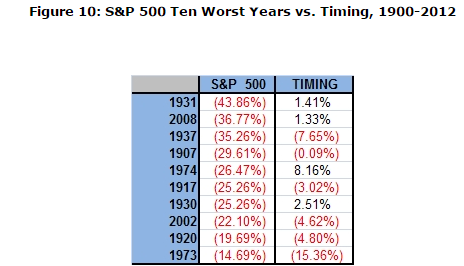
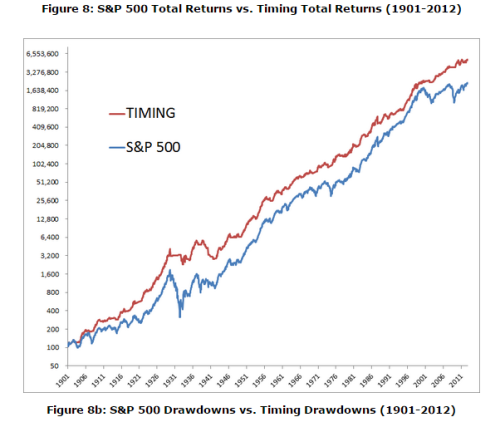
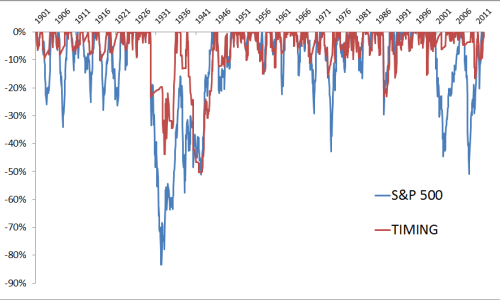
One of the best thing you can do as an investor/trader is to tune out the noise and accept the fact that you will never get out at the top or get in at the bottom. My suggestion is to stay optimistic about the market as long as it stays above the 200 day moving average (10 month moving average).  There’s not one single strategy that’s perfect, however, this one has a decent track record of keeping you in without having to deal with all the noise.  Meb Faber has done the best work on this, here are some of his charts on this subject.
SP500 Total returns vs. Timing Total returns (long above the 10 month average, out below the 10 month moving average).


image
image
image


SP500 vs The 200 day moving average


Photo; FitNyc

Things Can Change


When your trading time-frame is anywhere between 1-20 days a lot of the things that we believe are important are not. Trading books suggest that you should only buy a stock near its 52 week high, that it should be above a certain moving average, or that it should have earnings, etc....But very simply, if you take the time to study the biggest winners in the 1-20 day time-frame you might come up with different conclusions.  Don't be afraid.

These are the names on my swing trading list today; $MUSA $DRII $ENSG $EW $PLKI $DTSI $BABA $RH $LOCO $GNRC $MBLY $BERY $CHUY $MEP $COO $UAN $RUBI $CBOE

The Process;

Every morning I go through a few of my scans to find buy candidates for the day.  Depending on the current state of the market the size of the list will vary, usually its no more than 50 names.  My process is based on market structure not on beliefs or myths of what works– or what doesn’t work.  They are certain behavioral patterns that have been around for 100 years that are based on market structure, these behavioral patterns are recognizable, observable, and quantifiable.  On daily basis we have 3,000 stocks that we filter based on certain market structures that gives us an edge of a higher probability than a random outcome.  Once the list is narrowed to a handful of names the market will further narrow down the list by getting us in or keeping us out of these names with a range expansion move.
I don’t look at charts in your conventional cookie cutter manner, or have rules as to where the stock should be whether its 15% off its 52 week highs or above or below certain moving averages etc, in the short term none of that matters.
How much you put at risk per trade depends for the most part what your current outlook is for the market over the next 0-5 days.
Put these names on your trading platform, set the alerts at yesterday’s high for each name, once the alert goes off take a look at the chart, decided within 3 seconds whether or not you are going to buy it, decide how much you want to risk on the trade and your stop loss, hit the buy button, and leave the rest up to the market, wash, rinse, repeat.  Buy’em tight, Sell’em loose.
A few things that you should know about this swing strategy;
  •  Its main goal is to get you in when stocks are moving and keep you out in choppy/sloppy markets, it is imperative that you allowed the market to get you in only when the stocks go through their previous day’s high.
  • Your awareness of how the market is behaving is crucial, this will give you an idea of how hard to push the envelope.  My best indicator for this is my rolling 5 day watch-list.
  • Swing trading is a numbers game, you are going to be wrong half the time, risk management is above all, and many times you will have nothing to do because the market did not get you in. We are not looking for any action, we are looking for the right action.
  • Don’t be penny wise, don’t try to anticipate a move just because the chart looks good.  You can have a great looking tight set up with a stock coiling for 10 days but who is to say that it won’t coil for another 5 days.  If you anticipate the range expansion you might buy something that is not ready to go and it will only frustrate you and lower your odds of a winning trade.
  • For me this list is a one way list – long bias.  I do not look at this list as a long or short list, long and short are two different games with different dynamics.
  • You need to be extremely organized.  Most if not all your work will be done pre-market and you will spend the day just executing or you can just automated it with buy orders after 9:45am.
The information in this blog post represents my own opinions and does not contain a recommendation for any particular security or investment. I or my affiliates may hold positions or other interests in securities mentioned in the Blog, please see my Disclaimer page for my full disclaimer.
Photo; Marle-Chantale Turgeon